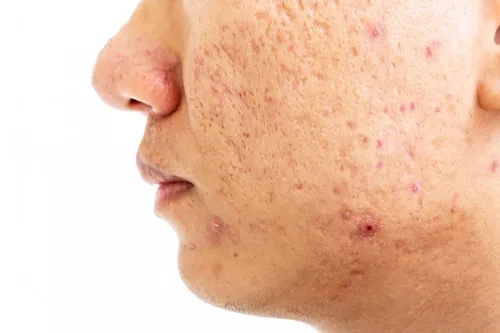
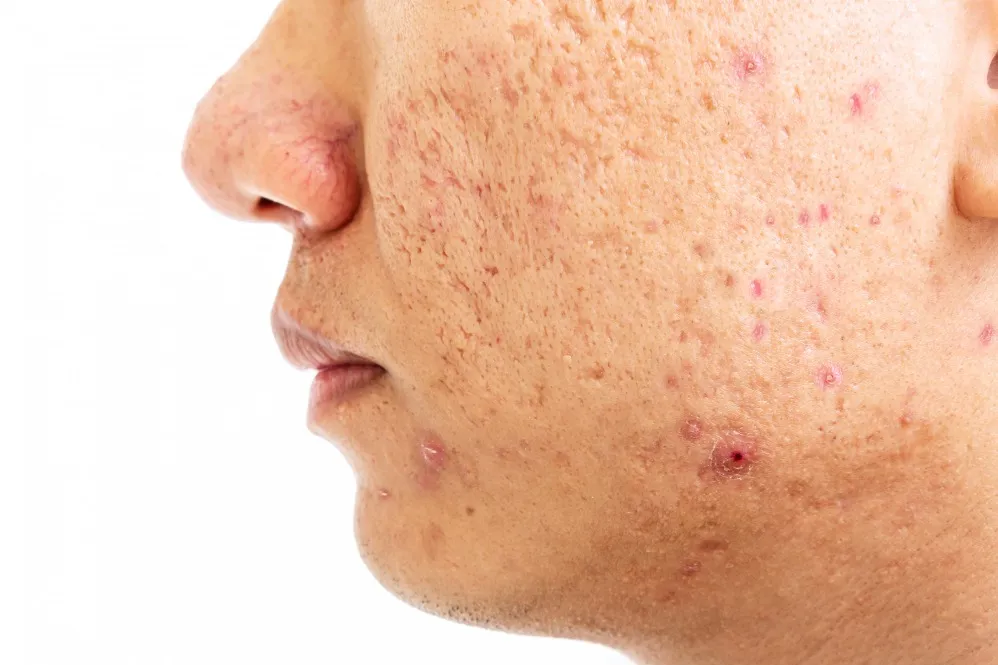
Acne may eventually settle, yet the marks it leaves behind can remain for years. Some people notice shallow depressions, others develop narrow deep scars, and some experience uneven texture across larger areas of the cheeks or temples.
This variation explains why Acne scar treatment is rarely a single procedure suitable for everyone.
The first step is identifying what type of change acne has actually left behind.
Acne Marks and Acne Scars Are Different
Flat red, brown, or dark marks following acne are often changes in skin colour rather than true scars.
Acne scars involve structural changes in the skin. They may appear as depressions, irregular texture, or raised areas.
Common depressed scar patterns include:
- Ice-pick scars that appear narrow and deep
- Boxcar scars with more defined edges
- Rolling scars that create an uneven or wave-like surface
Some people have more than one scar type at the same time.
Because pigmentation and structural scarring require different approaches, identifying the problem correctly prevents unrealistic expectations from skincare products alone.
Why One Procedure May Not Treat Every Scar
Different treatments affect the skin in different ways.
Depending on scar characteristics, dermatologists may consider approaches involving controlled resurfacing, collagen stimulation, scar release, targeted treatment of deeper scars, or combinations of techniques.
For example, a treatment that improves general texture may have limited effect on a deep tethered scar. Similarly, a technique designed for an individual deep scar may not be the most practical way to address widespread superficial texture.
This is why combination planning is commonly discussed for mixed acne scarring.
Active Acne Should Also Be Considered
Treating scars while significant new acne continues to develop can be frustrating because new scars may continue appearing.
Assessment may therefore include both the existing scars and the current acne activity.
A dermatologist may evaluate:
- Frequency of new breakouts
- Acne severity
- Current medications
- Tendency to develop pigmentation
- Previous scar procedures
- Skin sensitivity
- History of raised scars
- Expectations regarding downtime
Controlling active acne can become an important part of the overall plan.
Skin Tone Influences Treatment Planning
Indian skin tones can develop post-inflammatory pigmentation following irritation or inflammation. This does not mean procedures cannot be performed, but treatment selection, intensity, preparation, sun protection, and aftercare require thoughtful planning.
This is particularly relevant in Pune, where regular sun exposure can influence pigmentation and post-procedure care.
Daily photoprotection and following the recommended skincare routine are important parts of scar management.
Improvement Is Usually Progressive
Scar treatment should be approached with realistic expectations.
The goal is generally to soften scars, improve texture, and make irregularities less noticeable rather than promise completely flawless skin. The degree of improvement depends on scar depth, type, age, skin response, procedure selection, and number of treatment sessions.
Changes may also develop gradually because many procedures work partly by stimulating skin remodelling.
Assessment Comes Before the Procedure
At Skinzone Clinic, acne scar evaluation can focus on scar morphology, active acne, pigmentation tendency, previous treatments, and overall skin condition before treatment options are considered.
For someone researching acne scar treatment in Pune, Maharashtra, the useful question is not simply which procedure is most popular. It is which technique, or combination of techniques, matches the scars present on their skin.
Understanding that distinction can make scar treatment more targeted, realistic, and easier to plan.
Keywords